Mira Education
What is Collective Leadership?
This blog is part of our Unlocking Collective Leadership: 7 Conditions for Lasting Impact series, highlighting the conditions that help P20 systems move from individual effort to shared leadership.
A Lever for School Improvement
Long-lasting change doesn’t come from a program binder. It comes from people. At Mira Education, we’ve learned that unlocking a team’s full potential starts with how leadership is shared and supported.
Every school has untapped wisdom and expertise. What if we stopped overlooking it and started organizing leadership around it? Collective leadership isn’t a new program. Instead, it’s an approach that reimagines how teams work together.
From Buy-in to Co-ownership
Collective leadership allows educators to share the work in a way that builds ownership rather than buy-in. It’s more than task delegation. It unleashes educators’ collective expertise to solve problems and serve each student better.
Leadership thrives in schools where staff culture supports shared responsibility across roles, not just titles. In this approach, a team of educators shares leadership work in ways that move learners and learning communities toward improvement and innovation.
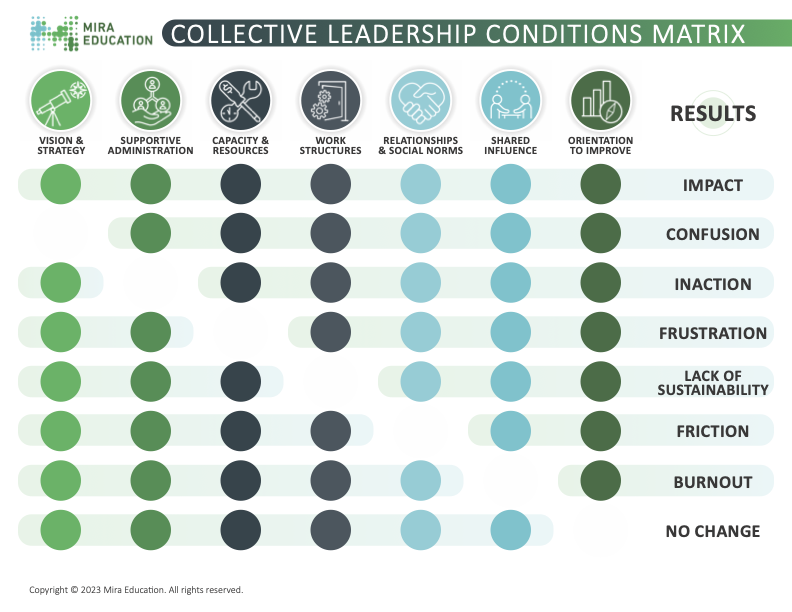
The Mira Education collective leadership development model aligns school and systems teams’ practice to support the following seven conditions shown to build collective efficacy, educator retention, and effective instructional and leadership practice:
- Vision and strategy
- Supportive administration
- Capacity and resources
- Work structures
- Relationships and social norms
- Shared influence
- Orientation toward improvement
Collective Leadership in Practice
Since 2017, Mira Education, in partnership with the South Carolina Department of Education, has supported schools across the state through the Collective Leadership Initiative (CLI). By building systems rooted in collective leadership, participating schools have seen measurable improvements in both staff and student outcomes.
Notably, between 2018 and 2023, the percentage of teachers who identified as leaders increased by 71%. In the 2023–2024 school year, 94% of CLI schools improved teacher retention.
These shifts in staff culture are translating into stronger student outcomes. Three CLI schools have earned national recognition for student achievement, and one school reduced office referrals by more than 75% within two years of joining the initiative.
This approach is not just about improving schools. It’s transforming how they work.
Small Shifts to Activate Collective Leadership
The best way to start reframing and reimaging your approach to leadership isn’t with a full rollout plan, but honest dialogue. The goal isn’t to have all the answers. It’s to surface the expertise already in the room and think differently about how you work together.
Here are some small but impactful next steps:
Gather a team of educators in different roles (administrators, teachers, instructional coaches, etc.) to discuss the following prompts:
- What untapped expertise already exists in our school/district? What evidence do we have about the presence of that expertise? (Note: Avoid relying on word-of-mouth.)
- Where and in what ways do we leverage expertise, and how can we expand those opportunities for others?
- What ongoing challenge do we face that would benefit from leveraging expertise to explore potential solutions?
Use the conditions matrix and this discussion tool to identify a condition your team wants to focus on to address your identified ongoing challenge.
Resources for Collective Leadership
Creating change and improvement is complex, challenging work. Collective leadership provides mutual support toward shared goals, allowing teachers and administrators to build collective efficacy and work better together. This discussion tool is a reflection guide to help you approach and navigate the Collective Leadership Conditions Matrix to gain insight into your team’s work.
Want help bringing collective leadership to life in your system? Learn more about Mira Education’s approach or reach out to start a conversation.
From Compliance to Co-Ownership
This blog is part of our Unlocking Collective Leadership: 7 Conditions for Lasting Impact series, highlighting the conditions that help P20 systems move from individual effort to shared leadership.
Why Shared Vision and Strategy Matter
A vision statement on a poster doesn’t mean much unless the people doing the work helped write it. In collective leadership, how we build a vision matters just as much as what it says.
As Margaret Wheatley put it, “No one is successful if they merely present a plan in finished form to others…” That’s why one of the core conditions of collective leadership is co-created vision and strategy. Let’s explore what that looks like in action.
What is Vision and Strategy?
Vision and Strategy comprise the first condition of collective leadership. It’s the shared North Star that guides a team’s decisions, priorities, and daily work.
In collective leadership, this means:
- Co-created: Developed collaboratively by the full team, across roles and titles
- Clearly defined: Specific enough to inform decisions and drive alignment
- Communicated and lived: Used consistently to shape culture, strategy, and practice
When teams get this right, everyone knows where they’re headed—and how they’ll get there together.
One school that embraced this condition early in its collective leadership journey is Dr. Rose Wilder Elementary School, where clarity of vision laid the foundation for deeper collaboration and stronger results.

Vision and Strategy in Practice
While few teams have the authority to craft a new vision statement for their school or district, all should have the opportunity to define what the vision means for their team in their current time and context. As a result, they’re more likely to have the chance to develop the strategy intended to meet the goals aligned with the vision.
Take Dr. Rose Wilder Elementary in Clarendon County. When two schools merged, the leadership team knew they couldn’t just graft one school’s identity onto another. Instead, they needed to create something new, together. So they approached the moment with intention:
- They set a mindset across the community: We’re building a new school,
- School leaders met one-on-one with staff from the former Summerton school to learn what was working and what needed attention,
- Committed to preserving effective practices while addressing persistent pain points, and
- Opened up the conversation, hosting family town halls to share transparently and invite feedback.
This wasn’t vision on paper. This was vision lived out loud. And the results spoke volumes: for the first time ever, Dr. Rose Wilder earned an Excellent rating on the state report card.
When vision is co-created and strategy is shared, results don’t just improve; they stick.
Turning Vision and Strategy Into Shared Action
Most teams don’t need a new vision. They need a shared one. Whether you’re launching a new initiative, tackling a persistent challenge, or navigating change, co-creating vision and strategy helps your team move in the same direction.
Gather the team and start here:
- What is our team currently working on, or something coming up, that could benefit from a co-created vision and strategy?
- If this effort we are currently working on were wildly successful, what would you see, hear, think, and say?
- What are the next three to five action steps to make the shared vision a reality?
- What can each team member contribute to ensure the wildly successful vision is realized?
- What resources and/or supports are needed to make those contributions?
Resources for Vision and Strategy
Ready to start the conversation? This facilitation guide offers step-by-step support for co-creating vision and strategy with your team, from identifying key stakeholders to building consensus. It’s designed to help teams move from ideas to shared action through a collective leadership lens.
Want tools, examples, and reflection prompts delivered straight to your inbox? Subscribe to the Unlocking Collective Leadership email series to dig deeper into each condition and explore how to bring collective leadership to life in your school or district.
A Better Way to Finish Strong
How Collective Leadership Helps School Leaders Finish Strong
The month of May is a marathon, not a sprint. Testing, hiring, celebrations, and next-year planning. It’s all happening at once, and the pressure to “finish strong” is real.
But for too many leaders, “finishing strong” gets translated into “doing more,” and often doing so alone.
There’s another way.
What Collective Leadership Looks Like at the End of the Year
The work may not be easier, but leaders in these schools and districts aren’t just surviving the end of the year. Rather, they’re designing it with their teams to co-own the work and the results. Here’s what that looks like in practice:
Desiloed Decision-Making
Instead of tackling hiring, planning, and budgeting in parallel conversations, they bring the work into one shared frame. In our work with the University of Maryland School Improvement Leadership Academy, principals and assistant principals focus on competency-based professional learning to sharpen their skills in inclusive leadership practice.
“SILA provided research with practical skills to improve school systems. With the skills I developed in SILA, we were able to increase our attendance rate this year from 70.1% to 83.1%.” Allison Johnson, J.D., NBCT, Assistant Principal, Anne Arundel County Public Schools
Distributed Reflection
Every team, not just administrators or the central office, has space to look back, name what worked, and surface what needs attention.
As part of our partnership with the South Carolina Department of Education, 31 schools across 15 districts are implementing collective leadership practices to spur improvement and reflect on what their schools need to be a thriving learning community.
Centered co-ownership
When the temptation to “just get it done” kicks in, they ask: Who else could lead this? And more importantly, who is already leading, but hasn’t been named?
By coming together to view student data as a team, Scott’s Branch Middle School was able to share to increase its capacity to support each student.
“Student achievement was always the core of our work. But the problem was we were all on our own islands. …Doing the data walls helped us see a clear picture of what each child needed.”—Caroline Mack, Teacher of the Year, Scott’s Branch Middle High School
When leaders aren’t carrying the load alone, they’re part of a system that holds together, even in the toughest weeks.
Try this
End-of-year pressure can make us default to “just get it done.” But co-leadership requires us to slow down and shift the approach. Try this:
- Map out a key end-of-year task that’s currently sitting on your plate. It could be anything from finalizing budgets to planning PD or preparing graduation events.
- Identify two other team members already contributing to this task, whether actively or behind the scenes.
- Name one action you can take to share the ownership of this task with them publicly: acknowledging their role in a meeting, shifting responsibility, or asking for their input on key decisions.
The goal isn’t just to share the workload. The goal is to co-own the process and outcomes as a team.
Learn more about how schools are implementing collective leadership to drive real change.
Uncertainty ≠ Instability: 4 Key Strategies for Education Leaders to Support Staff Through Change
Change in education is constant, but uncertainty doesn’t have to lead to instability or getting stuck. Education leaders play a crucial role in navigating the unpredictable nature of school improvement, curriculum shifts, and policy changes. By focusing on what’s within your control and supporting your staff through the unknown, you can lead confidently, reduce stress, and promote a healthy, collaborative school culture.
Here are four actionable strategies to help education leaders support their teams during uncertain times and create stability in change.
1. Focus on What You Can Control: Leadership Strategies for Success
In uncertain times, it’s easy to feel overwhelmed by factors beyond your control, like changes in education policy, fluctuating budgets, or evolving state mandates. However, focusing on what you can control is the most effective way to maintain stability within your team.
You can’t control everything, but you can control your leadership approach: how you communicate, how you advocate for resources, and how you support your staff. By focusing on these areas, you can avoid burnout and build a positive, proactive school culture.
Key Takeaway:
In times of uncertainty, education leaders should focus on the leadership actions and decisions within their control. If it is not yours to do, it is not yours to worry about. This maximizes the impact you can have and fosters resilience.
2. Communicate Early and Often: Building Trust with Transparent Leadership
Effective communication is one of an education leader’s most important tools during change. Proactive communication ensures that staff members are informed, reducing confusion and anxiety about potential shifts.
Whether it’s about curriculum updates, policy changes, or school-wide initiatives, keep your team in the loop early and often. By being transparent and consistent, you prevent assumptions and encourage a culture of trust. Staff should know they can rely on you for updates and information.
Key Takeaway:
Communication is the foundation of trust. Early and frequent updates are key to keeping staff informed and reducing uncertainty during periods of change.
3. Avoid Siloed Decision-Making: Promoting Collaboration Across Teams
Siloed decision-making can lead to misalignment and frustration, especially when facing uncertain times. When teams or leaders work in isolation, it often results in confusion and resistance to change. Instead, promote collaboration across teams and departments to ensure alignment and foster a shared sense of ownership.
Involve staff in decision-making processes early on and create open channels for feedback and collaboration. This ensures decisions are made with collective input, which boosts morale and reduces the risk of misunderstandings.
Key Takeaway:
Collaboration is essential for navigating uncertainty. Break down silos by ensuring decisions are made with input from all stakeholders, aligning your efforts across teams and departments.
4. Make Small Shifts for Meaningful Improvement: Sustainable School Change
Instead of waiting for large-scale changes, focus on small, incremental shifts that will drive long-term improvement. In times of uncertainty, making steady, manageable changes is more sustainable and less disruptive.
Rather than overhauling systems or processes, make consistent adjustments that can be refined over time. Whether revising a program, testing a new strategy, or making small tweaks to daily operations, these incremental changes lead to sustainable growth.
Key Takeaway:
Sustainable change comes from small, intentional shifts. Focus on incremental improvements rather than major disruptions for more significant long-term impact.
Looking for More Resources?
Leading during uncertain times doesn’t have to be overwhelming. By focusing on what you can control, communicating effectively, promoting collaboration, and making incremental improvements, you can guide your staff through unpredictable changes confidently and clearly.
For more tools and resources on leading through school change and supporting your team during uncertainty, visit www.miraeducation.org. Our free resources can help you lead for sustainable change and build a stronger, more resilient school culture.
Removing Barriers to Impact: How Education Leaders Can Find Focus in the Chaos
Why Education Leaders Get Stuck
Education leadership is filled with competing priorities — curriculum implementation, teacher retention, student success, and operational challenges. With so much happening at once, even the best plans can stall.
Maybe a new initiative isn’t gaining traction. Maybe a curriculum shift hasn’t delivered the expected student growth. Or maybe, despite endless meetings, the same challenges persist year after year.
When this happens, it’s often not because the ideas are wrong — it’s because barriers, like follow-through, misalignment, and outside factors, prevent real progress.
The solution? Removing barriers to impact — focusing on what truly matters and clearing the path for meaningful change.
How to Remove Barriers and Gain Momentum
As a design and implementation partner, we’ve helped school and district leaders refine their vision and strategy to meet their unique needs. The key? Harnessing collective leadership, aligning expertise with goals, and identifying what’s standing in the way of progress.
Here are three powerful ways education leaders can remove barriers, focus their efforts, and drive sustainable impact:
1. Leverage Expertise: Leadership is a Team Sport
The best school and district leaders don’t try to do it all alone. Collective leadership ensures that the right people are making decisions in their areas of expertise. When teams collaborate effectively, they remove roadblocks that slow down progress.
Action Step: Identify key strengths within your team. Who can take the lead in specific areas? How can you build leadership capacity across your school or district?
2. Step Back & Reflect: Use Data to Identify Roadblocks
Great education leaders don’t just collect data — they use it to pinpoint barriers and adjust strategies. Reflection isn’t just about checking progress; it’s about identifying what’s holding your team back.
Action Step: Schedule a data-driven reflection session with your team. Use both qualitative and quantitative data to assess progress, celebrate small wins, and adjust your school improvement plan accordingly. Download this tool to guide your session.
3. Turn Reflection into Action: Remove What No Longer Works
Reflection without action leads to frustration. The most effective education leaders take insights and turn them into concrete next steps—especially when it means eliminating outdated practices.
Action Step: After every strategy session, define one priority, assign ownership, and set a clear timeline for action. Removing unnecessary tasks and refining focus helps teams gain momentum. Download this tool to help you sort through initiatives and tasks to refine or remove.
Removing Barriers to Impact: A Mindset Shift for Education Leaders
Progress doesn’t come from doing more — it comes from focusing on what truly moves the needle. By stepping back, leveraging your team, and committing to actionable school leadership strategies, you can clear obstacles and create lasting change.
Feeling stuck? Let’s remove the barriers to impact together. Connect with Mira Education to build momentum and implement high-impact, sustainable school improvement solutions.
The Power of School Learning Labs
Observing Collective Leadership in Practice
How do schools make meaningful, sustainable change?
It’s a question educators ask themselves every school year.
In our work with partners, we’ve learned that big, innovative ideas do not always shake up a system. It’s the small shifts in practice that lead to sustainable school improvement.
Over the last seven years, Mira Education has partnered with the South Carolina Department of Education (SCDE) to support schools in making small shifts for significant impact through a collective leadership approach.
Collective leadership is a research-based approach that harnesses the expertise of each team member to multiply leadership capacity and bring more perspectives into the decision-making process.
Collective Leadership Initiative
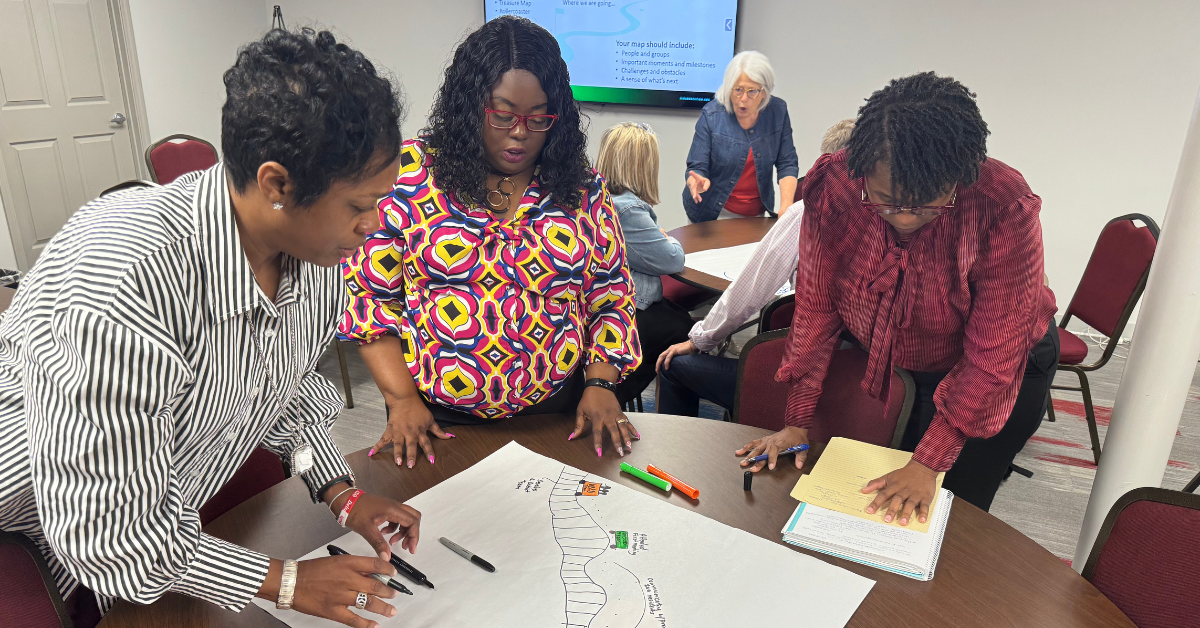
The Collective Leadership Initiative (CLI) was established in 2018, and 64 schools have participated in this partnership between Mira Education and the SCDE. As part of CLI, school teams across South Carolina come together to identify a Priority of Practice (PoP) for their schools. The PoP is a growth area for school teams will focus on for two years. Teams identify the actions needed to address their PoP and plan for small, sustainable shifts in their collective practice. To ensure there are a variety of perspectives and expertise at the table, CLI teams are comprised of educators across roles – administrators, teachers, and support staff.
But what does collective leadership look like in practice?
Learning Labs
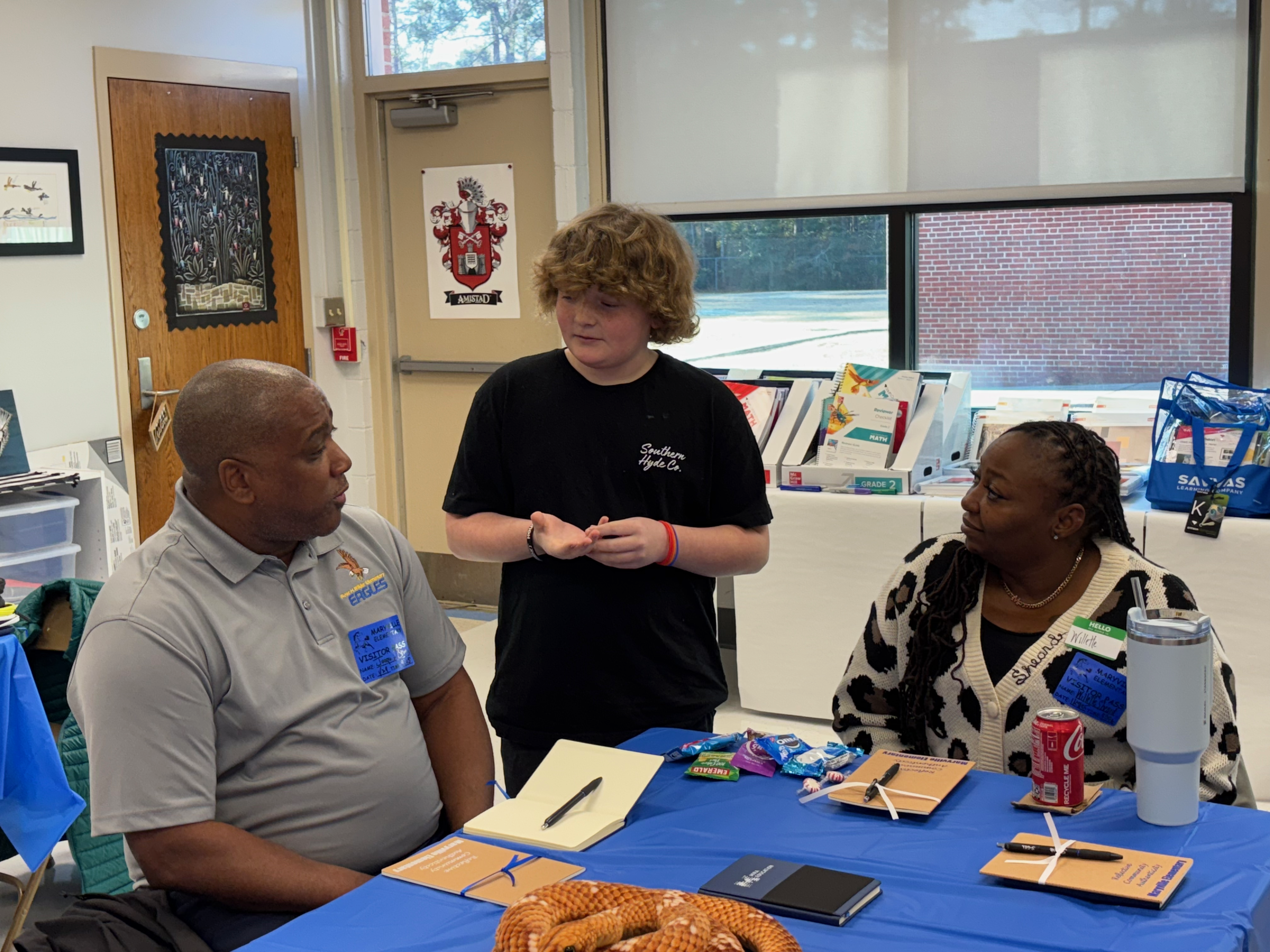
To support teams in answering this question and to offer inspiration for shared work, CLI schools participate in learning labs. Learning labs are school visits to other CLI schools to obserce the impact of collective leadership in classrooms in real time.
Recently, Mira Education and SCDE co-facilitated four learning labs at Blythewood High School, Horse Creek Academy, J.C. Lynch Elementary School, and Maryville Elementary School. While each host campus had its own style, all participants observed classrooms, heard from staff and students, and asked questions about the host campus’ collective leadership practice.
Additionally, each school team examined its efficacy survey data. The efficacy survey is an anonymous survey administered by CLI that measures the degree to which teachers believe they impact one another and student learning.
This data-reflection is part of the CLI planning process. Schools will come together again later this month to adjust their approach and identify potential shifts to their PoP to better support their team.
Learning labs effectively allow educators to see collective leadership in practice. They help the theoretical approaches learned in CLI become tangible and, more importantly, actionable.
For support identifying a Priority of Practice and to learn more about applying a collective leadership lens to your work, email info@miraeducation.org.
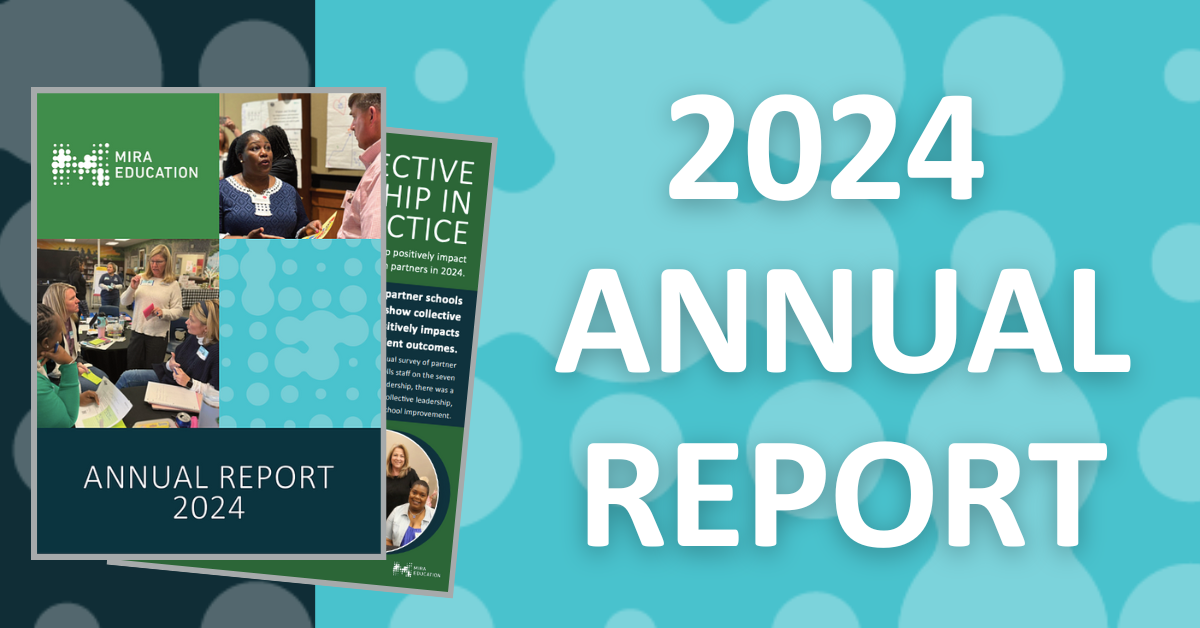
2024 Annual Report
As 2025 begins, the Mira Education team is inspired by the work accomplished in 2024 and encouraged by what’s to come. Read the 2024 Annual Report to see how collective leadership positively impacted students, schools, and districts in our work with partners.
3 Reflections to Lead School Improvement Planning
The end of the school year calls for both reflection and planning. In the midst of drafting master schedules and reimagining resources, school leadership teams must also take stock of what worked and what no longer serves their students and staff.
Assessing impact in the current year while also planning for the next can be overwhelming. It is even more so when you consider the increasing number of priorities that come with closing out the school year like standardized testing, setting the budget, and end-of-year celebrations – just to name a few.
There is an abundance of “how-tos” and “how-nots” when it comes to school improvement planning, but the expertise needed to make the right decisions for your school or district often lies within your team.
Use these three reflection prompts to unpack this school year and plan for the next.
1. At the beginning of the school year, what was the vision and goals for your students? For your team? How was that vision crafted?
A clear vision and strategy help orient your team and your shared work. Identifying a vision for both achievement and experience is paramount to shifting the work toward your desired outcomes. As you think about your vision for this last school year, recall how it was developed. Was it done alone or were others invited into the process?
By inviting others into the vision and strategy creation process, leadership multiplies. As the next iteration of the vision is developed, leverage the expertise across your team and across roles to increase the ownership of vision, strategy, and outcomes.
2. How did you support your team in the facilitation of this vision?
Supportive administration, whether on the district or the school level, is a key part of retaining talent and expertise. How leaders choose to not just involve staff in the vision and strategy but also support the work is pivotal for both retention and seeing that vision come to fruition. According to the EdWeek Research Center, of educators polled, having a more supportive principal/manager was the top reason they chose to stay in the profession.
As you reflect on this past year, what supports did you and other leaders offer to your team? Where could you shift your practice to be more supportive and attuned to staff needs?
3. How were capacity and resources aligned to support the vision and strategy for the year?
Capacity and resources are finite. That is a universal truth across education and across roles within each district and school. How you organize capacity and resources, however, can significantly impact the realization of your shared vision and strategy.
Consider how your team spent time this year. Was collaboration and planning time prioritized in the schedule? Was there space for cross-team learning? Time is just one of many resources you can leverage in support of your vision. Download our tool, Reimagining Your Resources, to facilitate a 90-minute discussion and recalibrate your resources to your shared vision.
As you dive into reflection, we invite you to extend that into team learning and discussion. Check out our book, Small Shifts, Meaningful Improvement, for additional tools and case studies on how to apply a collective leadership approach to your school improvement planning.
Planning for Shifts: 3 Approaches as ESSER Ends
Education was interrupted in 2020. From virtual learning to Personal Protective Equipment (PPE), the COVID-19 pandemic caused a significant shift in the profession. In response, the federal government bolstered district budgets with COVID relief funds. Now, just four years later, district leaders must shift again as those funds come to an end. Before the next school year, they will make hard decisions around ESSER funding and must pivot to meet the needs of students and staff.
What is ESSER funding?
The Elementary and Secondary School Emergency Relief Fund, commonly referred to as ESSER, is a federal program that gave districts nearly $190 billion in response to the pandemic. Districts have until the end of September to commit their share of ESSER funds and will have until January 2025 to spend them.
For some districts, ESSER funds allowed for new construction in response to growing communities. For others, it meant hiring more staff to support student needs. No matter where districts invested their funding, the time is coming for district leaders to make shifts in order to maintain momentum.
Planning for Shifts: 3 Approaches as ESSER Ends
Shifts in how districts and schools operate without ESSER funding are inevitable. Cuts are coming, if not already here. But instead of embracing a scarcity mindset, district and school leaders can proactively plan for change. These shifts won’t happen overnight and may be uncomfortable, but they present themselves as an opportunity to re-engage the people who make the work of districts and schools possible – educators.
1. Revisit Your Vision
In your leadership practice, how you approach vision and strategy is as important as the vision and strategy you set. Intentionally invite your team to help co-create the vision and strategy for next year. Though resources are shifting, what you decide as a team is priority will help you gain insight into where to make shifts.
At Manning High School, for example, after experiencing a year of growth, their team wanted to build on that momentum. In the 2023-2024 school year, they came together to rally behind a vision to Watch Achievement Rise or their “W.A.R.” cry to increase student outcomes. By engaging their entire school community in a vision of excellence, they saw a positive impact on report card metrics, discipline, attendance, and enrollment.
As you establish vision and strategy, use this facilitation guide to identify and connect with a range of team members and invite them into the decision-making process.
2. Reimagine Your Resources
After you’ve co-created the vision and strategy with your team, aligning resources is a critical next step to not only seeing that vision come to fruition but also sustaining shifts in your work. How you make strategic sense of existing programs and initiatives will allow you to let go of what’s no longer serving your team and make space for more of what is moving you closer to the set vision.
Walker-Gamble Elementary, an under-resourced school in rural South Carolina, has approached their resources in a way that centers teacher time and student outcomes. By making shifts in their master schedule, every teacher has at least five hours each week for professional learning and collaboration, 75 percent of students experience 1:1 instruction, and every student and educator sets data-informed personalized learning goals at least quarterly (Byrd et al., 2023). By making small shifts in their schedule and reimagining how they work together with their existing resources, Walker-Gamble received South Carolina’s top recognition for schools, the Palmetto’s Finest award in 2020.
Use this activity protocol to guide your thinking and reflect on existing programs and resources with your team. You will need up to 90 minutes for this work.
3. Embrace Fresh Perspectives
Finally, the work of leaders should not be done alone. As ESSER funding comes to an end, invite new perspectives into the planning and implementation of shifts in your shared work. By de-siloing the work to be done, your team becomes co-owners of your outcomes, strategy and vision, multiplying the leadership across your team.
In Richland County School District Two, district leaders are tapping into teacher expertise as part of the planning process for the next school year. To increase teacher engagement in decision-making, they have asked teachers to develop master schedules for the next year to center teacher capacity and time needs.
Creating change and improvement in schools and districts is complex, challenging work. Use this discussion tool with your team to gain insight into your work together.
From Planning to Action
As you prepare for shifts in the new school year, continue to engage your team in the design and implementation of solutions. You can find more free tools and resources on our website or contact our team for thought partnership and support.
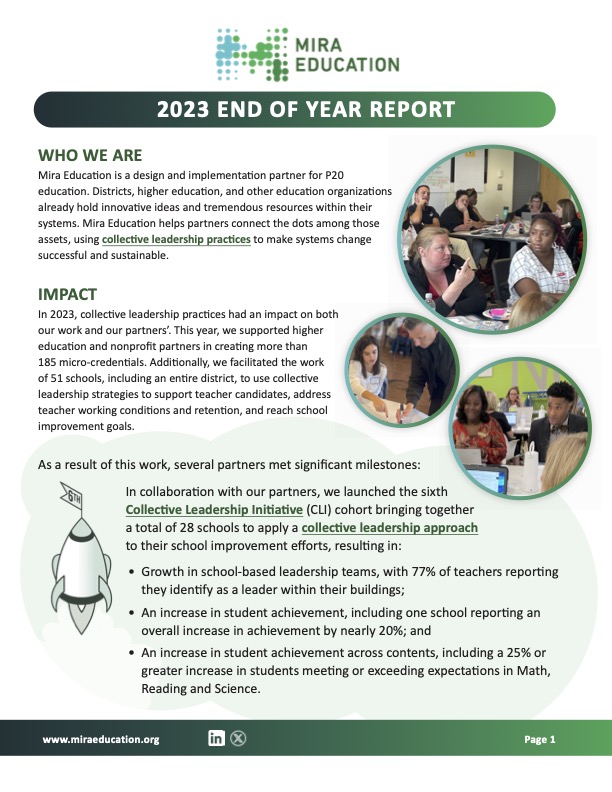
2023 End of Year Report
As 2023 comes to an end, we’re looking back at the work accomplished and are inspired by what’s to come. The End of Year Report highlights the impact of our work in 2023.
This year, we met several milestones as an organization, including publishing a new book, Small Shifts, Meaningful Improvement, developing free tools for leading change and improvements in districts, and working alongside our partners to increase teacher retention, bolster school improvement efforts, and make sustainable changes across schools and districts.
Read the full report below and connect with us on social media for more updates and resources for school improvement and education leadership.