
Day: July 18, 2025
Work Smarter, Not Harder
This blog is part of our Unlocking Collective Leadership: 7 Conditions for Lasting Impact series, highlighting the conditions that help P20 systems move from individual effort to shared leadership.
The Role of Work Structures in Collective Leadership
A solid strategy won’t get far without the right structures in place to support it. Educators are expected to collaborate, lead, and improve, but even the best efforts stall out when the systems around them don’t support that work. Work structures, such as how we schedule time, set priorities, and make decisions, are what make sustainable improvement possible. In collective leadership, those structures are intentionally designed to support shared ownership of the work.
Time and effort are precious. The right structures protect them. Here’s how to build routines that make school improvement work possible.
What is Work Structures?
Work Structures are the fourth condition of collective leadership. They include the rhythms and routines that guide how a school or team functions, such as calendars, schedules, meeting structures, planning processes, and communication norms.
In collective leadership, these structures are designed to support shared priorities. That means:
- Protecting time for collaboration
- Aligning day-to-day operations with long-term goals
- Reducing friction and confusion in how work gets done
When this condition is in place, teams gain clarity, coherence, and the capacity to lead well, without burning out. Work feels purposeful. Meetings get smarter. And people can spend less time navigating logistics and more time driving improvements.
One school that has put this condition into action is Maryville Elementary, whose intentional focus on instructional improvement has led to increased staff and student engagement, as well as a decrease in student referrals.
Work Structures in Practice
At Maryville Elementary, sustainable work was about more than managing busy schedules. It began with aligning around shared priorities for feedback and instructional expertise. The staff came together to reimagine observation practices, increasing two-way informal feedback among teachers. This shift strengthened staff culture and had a clear, positive impact on students.
Through behavioral learning walks, the school cultivated a culture of vulnerability and shared learning, intentionally focusing on improving student engagement and outcomes.
The results speak volumes: academic performance rose from Below Average to Average on the 2024-2025 School Report Card, and student referrals dropped by more than 76 percent.
When teams prioritize collaboration and continuous learning, meaningful change follows. This is the power of collective leadership in action.
Pressure or Progress? A Team Check-In on Work Structures
Gather the team and ask the following prompts:
- What gets prioritized in our schedule—and what consistently gets squeezed out?
- How do our routines and meetings support (or stall) meaningful work?
- Which structures help us work collaboratively, and which reinforce silos?
Resources for Work Structures
Ready to take a closer look at how your team’s work structures support shared leadership? Use this reflection tool to track your time, identify misaligned routines, and find one shift you can make toward stronger collaboration.
Want tools, examples, and reflection prompts delivered straight to your inbox? Subscribe to the Unlocking Collective Leadership email series to dig deeper into each condition and explore how to bring collective leadership to life in your school or district.
Building the Foundation for Sustainable School Improvement
This blog is part of our Unlocking Collective Leadership: 7 Conditions for Lasting Impact series, highlighting the conditions that help P20 systems move from individual effort to shared leadership.
Making Capacity and Resources Work for Your Team
A bold vision means little without the capacity to act on it. Educators are often asked to lead, innovate, and improve without the time, tools, or staffing to do it well. The result? Frustration, burnout, and stalled momentum.
Collective leadership doesn’t mean doing more with less. It means building the conditions that make school improvement not just possible, but sustainable. This means starting with real investment in time, tools, and support.
Let’s break down what this means and how it shows up in practice.
What is Capacity and Resources?
Collaboration becomes more than a buzzword when schools have the right resources in the right places and the flexibility to use them well. It becomes a daily habit.
Capacity and Resources is the third condition of collective leadership. It’s about how people, time, funding, space, and expertise are leveraged to support shared goals. When this condition is off, progress can feel like pushing uphill.
Some questions to consider:
- Do your structures match your goals?
- Are you investing in people’s ability to lead, or asking them to figure it out on the margins?
Without a clear foundation for support, even the strongest teams can’t sustain momentum.
One school that tackled this head-on was Walker-Gamble Elementary, where rethinking how time was used became a breakthrough for both student growth and teacher collaboration.
Capacity and Resources in Practice
When schools rethink how they use what they already have, like time, talent, and trust, big things can happen. In our partner work, we’ve seen how capacity unlocks stronger collaboration and smarter problem-solving.
Walker-Gamble, a school we’ve partnered with through the South Carolina Department of Education’s Collective Leadership Initiative, was committed to seeing its students grow. For their team, this meant prioritizing the amount and quality of instructional time in each day’s schedule. Through a time auditing process, their team reimagined their bell schedule together to protect planning time and provide additional time for cross-team collaboration.
The result? A sharper focus on instruction, stronger team cohesion, and national recognition. Walker-Gamble was named a 2023 National ESEA Distinguished School for Exceptional Student Performance and Academic Growth and continues to see steady gains in student outcomes and staff engagement.
Curious what this looks like in practice? Read more about Walker-Gamble’s collective leadership journey.
Pressure or Possibility? A Team Check-In on Capacity
When the work starts to feel unsustainable or stalled, it’s often a signal that something deeper needs adjusting. Use these questions to reflect as a team:
- Where does leadership work currently happen in our schedule, and where does it get squeezed out? Naming this openly can reveal the invisible toll it’s taking on your team.
- Do our structures and staffing models support distributed leadership or reinforce traditional hierarchies? You might find it’s time to rethink who has protected time, decision-making power, or access to information.
- What are the “unspoken” resource barriers our team faces, and how are we addressing them? Whether it’s time, tech, PD, or trust—naming these gaps is the first step to closing them.
Collective leadership requires shared effort, but it also requires shared investment. These questions can help you identify what’s missing and where to begin making real, structural shifts.
Resources for Capacity and Resources
Ready to take a closer look at your own team’s capacity and resources? Use this tool to explore the structures that support or limit your team’s capacity. We recommend using this tool with a cross-role group and identifying one small shift you can make to increase shared leadership by reallocating time, tools, or support.
Want tools, examples, and reflection prompts delivered straight to your inbox? Subscribe to theUnlocking Collective Leadership email series to dig deeper into each condition and explore how to bring collective leadership to life in your school or district.
Leadership that Moves School Improvement Forward
This blog is part of our Unlocking Collective Leadership: 7 Conditions for Lasting Impact series, highlighting the conditions that help P20 systems move from individual effort to shared leadership.
Driving Change through Supportive Administration
Educators are constantly navigating a flood of shifting demands. New initiatives. Urgent needs. Limited time. In all this churn, collaboration helps, but it’s not enough. Collective leadership thrives when leaders don’t just “allow” change, but actively support and champion it.
Supportive administration isn’t about checking boxes or offering an open-door policy; it’s about fostering a culture of trust and respect. It’s about ensuring every educator knows their work is seen, valued, and aligned to shared goals.
What is Supportive Administration?
Supportive Administration is the second condition of collective leadership. It refers to the visible, formal support that leaders provide to staff across all roles.
In collective leadership, this looks like:
- Aligning on shared goals
- Creating clear, coordinated plans
- Backing teams with the resources and structures they need to lead
It’s about more than agreement—it’s about shared direction and active reinforcement. When formal leaders and staff are moving together with clarity and consistency, schools are better positioned to turn ideas into action and make improvement stick.
One district that’s seen the impact of this approach firsthand is Clarendon County, where leaders prioritized formal supports to grow teacher leadership across their schools.
Supportive Administration in Practice
Over the last several years, the Clarendon County School District has undergone multiple consolidations, resulting in shifts in both its district identity and the way school teams work together. Despite this unexpected change, the district continues to experience growth.
During the 2023–2024 school year, the number of teachers who saw themselves as leaders jumped by 78%, speaking to the power and impact of a supportive leadership team.
When administrators model trust, make space for teacher voice, and follow through on shared decisions, leadership doesn’t just expand; it sticks. Clarendon County’s experience shows what’s possible when support isn’t just offered, but embedded.
Making Leadership Visible
Being a supportive administrator takes more than good intentions. It requires visible, tangible practices that help staff feel seen, supported, and aligned. Use these questions with your team or as part of an individual reflection to examine how leadership shows up in your daily work.
- What does visible support look like to your team, and are they experiencing it consistently?
- How is space created for others to lead?
- Are your systems and routines reinforcing collective ownership, or working against it?
- What’s one tangible thing you can do this week to show alignment and trust?
Resources for Supportive Administration
Inviting others into your practice allows you to see the work from a different perspective. You can build trust across teams and invite others into the improvement process by fostering intentional feedback loops. This tool walks leaders through a simple process to invite others into decision-making, starting with small steps and building to deeper, sustained collaboration. Use it to build trust, create feedback loops, and shift the leadership culture in your school.
Download the facilitation tool to make your leadership more inclusive, visible, and trusted.
Want help bringing collective leadership to life in your system? Learn more about Mira Education’s approach or reach out to start a conversation.
What is Collective Leadership?
This blog is part of our Unlocking Collective Leadership: 7 Conditions for Lasting Impact series, highlighting the conditions that help P20 systems move from individual effort to shared leadership.
A Lever for School Improvement
Long-lasting change doesn’t come from a program binder. It comes from people. At Mira Education, we’ve learned that unlocking a team’s full potential starts with how leadership is shared and supported.
Every school has untapped wisdom and expertise. What if we stopped overlooking it and started organizing leadership around it? Collective leadership isn’t a new program. Instead, it’s an approach that reimagines how teams work together.
From Buy-in to Co-ownership
Collective leadership allows educators to share the work in a way that builds ownership rather than buy-in. It’s more than task delegation. It unleashes educators’ collective expertise to solve problems and serve each student better.
Leadership thrives in schools where staff culture supports shared responsibility across roles, not just titles. In this approach, a team of educators shares leadership work in ways that move learners and learning communities toward improvement and innovation.
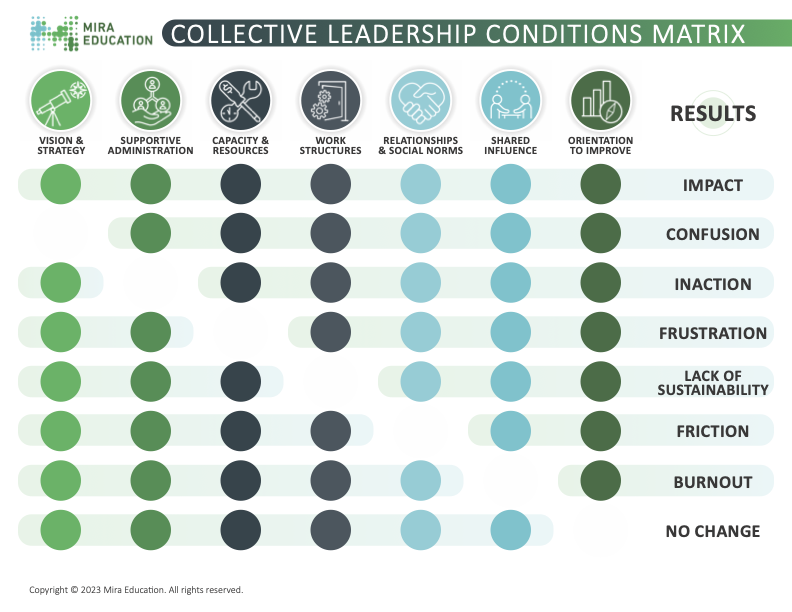
The Mira Education collective leadership development model aligns school and systems teams’ practice to support the following seven conditions shown to build collective efficacy, educator retention, and effective instructional and leadership practice:
- Vision and strategy
- Supportive administration
- Capacity and resources
- Work structures
- Relationships and social norms
- Shared influence
- Orientation toward improvement
Collective Leadership in Practice
Since 2017, Mira Education, in partnership with the South Carolina Department of Education, has supported schools across the state through the Collective Leadership Initiative (CLI). By building systems rooted in collective leadership, participating schools have seen measurable improvements in both staff and student outcomes.
Notably, between 2018 and 2023, the percentage of teachers who identified as leaders increased by 71%. In the 2023–2024 school year, 94% of CLI schools improved teacher retention.
These shifts in staff culture are translating into stronger student outcomes. Three CLI schools have earned national recognition for student achievement, and one school reduced office referrals by more than 75% within two years of joining the initiative.
This approach is not just about improving schools. It’s transforming how they work.
Small Shifts to Activate Collective Leadership
The best way to start reframing and reimaging your approach to leadership isn’t with a full rollout plan, but honest dialogue. The goal isn’t to have all the answers. It’s to surface the expertise already in the room and think differently about how you work together.
Here are some small but impactful next steps:
Gather a team of educators in different roles (administrators, teachers, instructional coaches, etc.) to discuss the following prompts:
- What untapped expertise already exists in our school/district? What evidence do we have about the presence of that expertise? (Note: Avoid relying on word-of-mouth.)
- Where and in what ways do we leverage expertise, and how can we expand those opportunities for others?
- What ongoing challenge do we face that would benefit from leveraging expertise to explore potential solutions?
Use the conditions matrix and this discussion tool to identify a condition your team wants to focus on to address your identified ongoing challenge.
Resources for Collective Leadership
Creating change and improvement is complex, challenging work. Collective leadership provides mutual support toward shared goals, allowing teachers and administrators to build collective efficacy and work better together. This discussion tool is a reflection guide to help you approach and navigate the Collective Leadership Conditions Matrix to gain insight into your team’s work.
Want help bringing collective leadership to life in your system? Learn more about Mira Education’s approach or reach out to start a conversation.
From Compliance to Co-Ownership
This blog is part of our Unlocking Collective Leadership: 7 Conditions for Lasting Impact series, highlighting the conditions that help P20 systems move from individual effort to shared leadership.
Why Shared Vision and Strategy Matter
A vision statement on a poster doesn’t mean much unless the people doing the work helped write it. In collective leadership, how we build a vision matters just as much as what it says.
As Margaret Wheatley put it, “No one is successful if they merely present a plan in finished form to others…” That’s why one of the core conditions of collective leadership is co-created vision and strategy. Let’s explore what that looks like in action.
What is Vision and Strategy?
Vision and Strategy comprise the first condition of collective leadership. It’s the shared North Star that guides a team’s decisions, priorities, and daily work.
In collective leadership, this means:
- Co-created: Developed collaboratively by the full team, across roles and titles
- Clearly defined: Specific enough to inform decisions and drive alignment
- Communicated and lived: Used consistently to shape culture, strategy, and practice
When teams get this right, everyone knows where they’re headed—and how they’ll get there together.
One school that embraced this condition early in its collective leadership journey is Dr. Rose Wilder Elementary School, where clarity of vision laid the foundation for deeper collaboration and stronger results.

Vision and Strategy in Practice
While few teams have the authority to craft a new vision statement for their school or district, all should have the opportunity to define what the vision means for their team in their current time and context. As a result, they’re more likely to have the chance to develop the strategy intended to meet the goals aligned with the vision.
Take Dr. Rose Wilder Elementary in Clarendon County. When two schools merged, the leadership team knew they couldn’t just graft one school’s identity onto another. Instead, they needed to create something new, together. So they approached the moment with intention:
- They set a mindset across the community: We’re building a new school,
- School leaders met one-on-one with staff from the former Summerton school to learn what was working and what needed attention,
- Committed to preserving effective practices while addressing persistent pain points, and
- Opened up the conversation, hosting family town halls to share transparently and invite feedback.
This wasn’t vision on paper. This was vision lived out loud. And the results spoke volumes: for the first time ever, Dr. Rose Wilder earned an Excellent rating on the state report card.
When vision is co-created and strategy is shared, results don’t just improve; they stick.
Turning Vision and Strategy Into Shared Action
Most teams don’t need a new vision. They need a shared one. Whether you’re launching a new initiative, tackling a persistent challenge, or navigating change, co-creating vision and strategy helps your team move in the same direction.
Gather the team and start here:
- What is our team currently working on, or something coming up, that could benefit from a co-created vision and strategy?
- If this effort we are currently working on were wildly successful, what would you see, hear, think, and say?
- What are the next three to five action steps to make the shared vision a reality?
- What can each team member contribute to ensure the wildly successful vision is realized?
- What resources and/or supports are needed to make those contributions?
Resources for Vision and Strategy
Ready to start the conversation? This facilitation guide offers step-by-step support for co-creating vision and strategy with your team, from identifying key stakeholders to building consensus. It’s designed to help teams move from ideas to shared action through a collective leadership lens.
Want tools, examples, and reflection prompts delivered straight to your inbox? Subscribe to the Unlocking Collective Leadership email series to dig deeper into each condition and explore how to bring collective leadership to life in your school or district.


